Are robots really taking over our jobs, as some doomsday scenarios show? At NRC's seminar on the robot economy, optimism prevails, including on the deployment of robots in warehouses. "What we are making our people do now are inhuman tasks," he said.
In a recent report, the World Economic Forum predicts that by 2025, as much as 52 per cent of all work will be done by machines. Today, the figure is only 29 per cent. Where will the advance of machines and robots stop? Will they soon take control of our warehouses too?
Robot Brain
Robots can do many things, but also a lot of things they cannot. So says Martijn Wisse, professor of biorobotics at Delft University of Technology. Like almost every speaker at the NRC event, he shows a video from Boston Dynamics. It shows a robot running, jumping and doing somersaults. "That is mainly a nice piece of electromechanical engineering, but not the reason why robots are on the rise now. In terms of robot brains, Boston Dynamics' developments are less impressive."
More impressive are the achievements of AlphaGo, the robot that beat the world champion in the board game Go last year. "The number of possible board combinations in Go is a 1 with 170 zeros. Amazing that a computer can make something out of this. It does this by simulating billions of game situations, an example of 'reinforcement learning'," Wisse says.
Building understanding
In logistics, another type of algorithm is on the rise: 'deep learning'. "That is nothing more than showing a computer millions of pictures of objects and asking what it sees. As a result, that computer learns to recognise the objects, even if it's a photo it hasn't seen before," explains Wisse, who together with his team won the Amazon Picking Challenge in summer 2016 based on this type of algorithm.
So robots can recognise many situations and objects and even deal with some variation in them. But that is not the same as actually understanding what they see. "The human brain works differently from a robot brain. When people see an unfamiliar object, their brain makes a prediction of what they see. The brain checks that prediction against perception, then adjusts that prediction. This is actually a form of 'jumping to conclusions'. That's how understanding is built. Robots cannot do that yet," Wisse knows.
Distributing control
So to the question of whether humans can control robots, the answer at the moment is yes. But actually that is not a good question, argues Wisse. "As a human being, on the contrary, you don't always want to be in control. Think of the moment you have to hit the brakes hard in your car. Then it is nice that the ABS system takes over control and prevents the wheels from locking."
A better question is how we will share control between humans and machines. "Take an autonomous driving car. If it gets into a situation that the autopilot cannot handle, the driver has to go back into action himself. However, research shows that it takes that driver seven seconds to become alert again. Switching off autopilot from one moment to the next therefore leads to accidents. Other solutions are needed for that."
Robots for order picking
Vanderlande outlines three phases in the advance of robots in logistics. The first phase concerns the deployment of robots for clearly defined tasks without variation. These are, for example, the welding robots that are on the assembly line in car factories. "Now we have entered the second phase where we can deploy robots for tasks with more variation," states Vincent Kwaks, chief technology officer of Vanderlande.
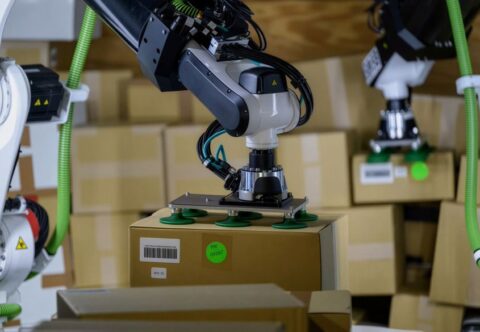
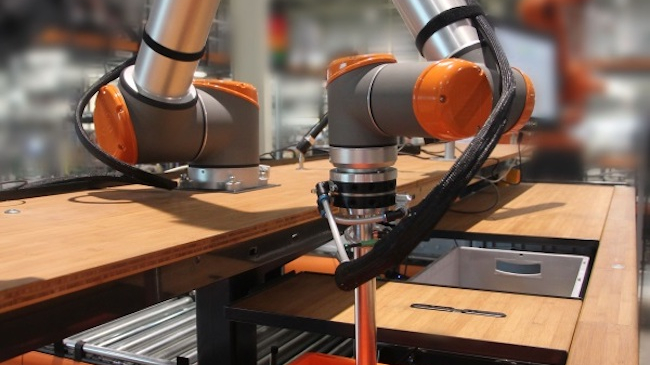
Vanderlande, for example, is working with technical wholesaler Würth to deploy robots at order picking stations. "That wholesaler has 50 distribution centres around the world and an assortment of over a million items. The robot can automatically pick 80 to 85 per cent of the assortment, the other articles still require an employee. That means one employee will soon be able to operate ten order-picking stations," says Kwaks.
Autonomous driving robots
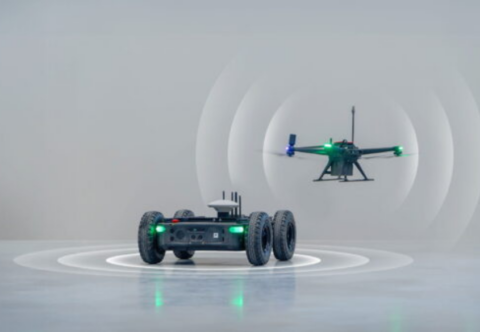
The third phase involves autonomous driving robots: robots that can find their own way through the warehouse and pick orders. Kwaks shows a picture by US systems integrator Bastian, which shows an AGV with 16 totes and a robotic arm. "That third generation of robots in logistics is coming," he says.
During the workshop on the deployment of robots in logistics, Herbert ten Have of Fizyr questioned autonomously driving picking robots in warehouses. Half the time, that robot is on the road and basically does nothing. "An investment in such a robot hardly pays for itself. Robots only provide real value when combined with goods-to-man systems," says Ten Have, whose company grew out of the team that won the Amazon Picking Challenge two years ago on behalf of TU Delft.
133 million new jobs
The World Economic Forum is optimistic about the rise of robots. While this will cause 75 million jobs to disappear over the next five years, it will be offset by 133 million new jobs. Koert van Mensvoort of Next Nature Network believes that robotisation and other new technologies will lead to new jobs we cannot yet imagine. He mentions organ designers making improved kidneys with the help of 3D printers or physiotherapists with six arms instead of two.
Whether new jobs will also be created in warehouses - besides those for robot management and maintenance - is doubtful. The question is whether we should mourn the loss of jobs for which people are already increasingly difficult to get. Ten Have points to the people driven by algorithms only being used to pick up and move goods. "Those are often inhuman tasks. We should be glad to be rid of that soon."
Marcel te Lindert - Journalist logistics & supply chain