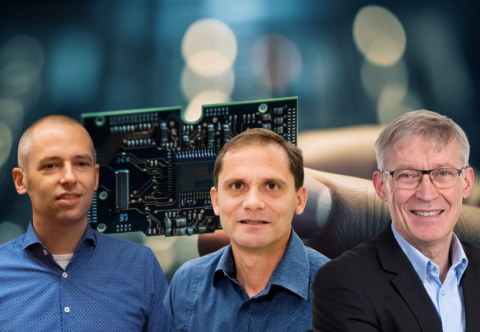
Technology completely turns the world of the logistics manager upside down. The three managers who made it to the finals of Logistics Manager of the Year know how to take on that revamped role extremely well. With just a few weeks to go until the grand final on 28 March, the candidates talk about their achievements and throw for the title.
Erik van Wunnik - Director Product Development at DSV Solutions
 According to finalist Erik van Wunnik (43), the logistics sector is far too modest. The Director Product Development at DSV Solutions Netherlands sees it partly as his task to put the sector in a positive light, for example by vlogging about the possibilities of 3D printing.
Van Wunnik is responsible for the development of new supply chain products at logistics service provider DSV. These can be certain services, but also markets with potential that DSV has not yet tapped into. About four years ago, Van Wunnik came across 3D printing in that role. The Director Product Development immersed himself in the concept and gave a workshop at DSV in which he explained to DSV country directors what 3D printing could bring to the industry.
'The enthusiasm spreads like an oil slick'
DSV's country directors - like Van Wunnik - were enthusiastic about the concept, but had numerous questions. "That's where I came up with the idea of setting up a 3D Exploration Lab, a place where logistics solutions are devised and printed directly." With that lab, we were able to answer the questions from DSV. By now, everyone is enthusiastic. That enthusiasm is spreading like an oil slick."
In the 3D Exploration Lab, logistics solutions are devised that DSV uses to improve its processes. As an example, Van Wunnik mentions the Pallet Support Tool, a tool around a pallet. "When we need to pick longer boxes in our operation, two people have to do the first few boxes together before one can drive on stably. One of the employees came up with the idea of making support around the pallet that is taken along during the picking process. Then a picker does not have to take an extra person along for the first boxes. He submitted that idea to us and two weeks later it was there."
To arrive at good 3D printed solutions for DSV, Van Wunnik depends largely on input from the shop floor. A clear protocol has therefore been drawn up to make giving input clear and approachable. "On a form, the employee fills in who the idea comes from, what the frustration is and what the solution should look like." They submit that form to the lab. There, they examine whether it is printable and what it will cost." In the department, they then decide what the business case is. They get that validated and then we go and print it and implement it."
"Ideas suddenly emerge because people are starting to understand that there is absolutely no limit," Van Wunnik continues. "Anything is possible. Because we do it ourselves, the cost of validating ideas is not high. Does something turn out not to work in practice? Then we can switch in an instant."
Director Product Development sees 3D printing as a 'huge opportunity for BV Nederland'. A year after setting up the lab, he has emerged as a true ambassador of the technology. Flogging has started from the 3D Exploration Lab and Van Wunnik is invited to speak worldwide. "I really enjoy doing that. Many people see 3D printing as a threat to logistics, when in fact it offers so many opportunities. That's why I engage with everyone, including competitors."
His participation in the Logistic Manager of the Year election is also right up his street. "It is important that the new Logistics Manager of the Year is concerned with the future and involves everyone in it. I think I am able to bring people along in my enthusiasm for the logistics profession. Our profession involves so much more than shifting pallets."
Gerhard Kolk - Director Operations at Koopman Autotransport

In 2015, Koopman Autotransport set itself the goal of growing by over 70 per cent in nine years. It was up to Gerhard Kolk (47), Director of Operations at Koopman, to facilitate that growth. "Those challenges that seem impossible and then succeed at the end. Nothing more fun than that."
As Director of Operations at Koopman Autotransport, Kolk provides day-to-day leadership to some 400 people and manages the company's 285 trucks that operate across Europe.
'There was little room to invest'
Many a logistician would already have his hands full, were it not for the fact that Koopman Autotransport decided in 2015 that it wanted to grow substantially without compromising on profitability. "We had the ambition to grow from 58 million to 100 million euros in nine years . There actually had to be a whole new business alongside the existing one. At the time, we were just coming out of a financial crisis that had left its mark. There was little room to invest, partly because the labour market for good drivers is extremely tight."
Kolk had shortly before completed the EMlog programme (Executive Master Supply Chain Management & Logistics) and decided to implement one of the logistics concepts he picked up there. This concept is based on four main pillars. "The first pillar was mapping the logistics network. Where are our partners located? And which partners could possibly support us in expansion? That would save us another investment."
The second pillar zooms in on planning and control. "The moment you have insight into your network, you have to think: how am I going to plan that as efficiently as possible?
Kolk then explored how he could support this with the right ICT processes. He named three key projects: digitisation, big data and blockchain. Last year, thanks to the use of blockchain, Koopman Autotransport managed to deliver a car without a paper consignment note. Using big data, Koopman Autotransport can extract predictive value from the orders it receives. "This way, we can send a truck somewhere even before we have an order," he says.
Of course, the above stands or falls with the behaviour of the people on the shop floor. The fourth pillar therefore revolves around the organisation. "That is the most important pillar, the people who do it. With us, it's all about logistics and entrepreneurship. Every employee has to be an entrepreneur. We have put all the projects away in different project groups. They have given hands and feet to all those projects."
According to Kolk, a "robust, profitable logistics concept" has now been established. "We have built a business alongside our business," he said. Currently, Koopman is running a turnover of €78 million. "Wenow have a certain vision of the future, but the car market is changing a lot. People want to use rather than own a car. We have to be able to act quickly on that and we are now equipped to do that."
What makes Kolk the Logistic Manager of the Year? "I think I have been exceptionally good at setting up a profitable strategic concept to achieve growth without expansion investments. Vision, entrepreneurship and being able to deal well with people. That is my great strength and I do it with great pleasure."
Job Sonke - Logistics manager at Hollister Inc.

As logistics manager in the European distribution centre of Hollister Inc., Job Sonke (49) has to constantly navigate between the American performance culture and the Dutch consultation culture. And he does that quite well. "Despite all the competition from low-wage countries, the US headquarters still gives us the confidence by staying in the Netherlands."
Sonke was commissioned in 2007 by Hollister, a US medical device manufacturer, to concentrate the company's European distribution in West Brabant. "At the time, those operations were still fragmented across Europe. I started shaping that central distribution centre. I still lead that today."
'The added value is mainly in the staff. People have logistics feeling'
In 2016, Hollister had to look for a bigger location for its European operations. In doing so, it again chose the Netherlands. Within a year, all employees, equipment and products moved to new 30,000-square-metre premises in Oud Gastel. "That went in a very ambitious time frame. In December 2017, the premises were completed and within three months we moved all products, without our customers noticing anything."
"This is largely because we gave a lot of attention to change management within the organisation. We included everyone in every step. In the end, all the staff moved with us to the new location. We are quite proud of that."
Sonke is also proud of the fact that Hollister chose the Netherlands as its European location again after ten years. "That is a great compliment. They could also have chosen a country in Eastern Europe when relocating, for example. Apparently, what we have put in place here works well for Hollister. Of course, the Netherlands has a strategic location, close to ports. But the added value is mainly in the staff. People here have a feeling for logistics. This is how we create efficient logistics chains. We don't go for the cheapest staff and short employment contracts. We want committed people who fit the culture of the company."
Why engaged staff is so important to Hollister? Because the company manufactures medical devices. "Hollister's mission is to make the lives of people who need our products more valuable and dignified. In that, you don't want to do a half-assed job. That has big implications. We constantly try to include that in the steps we take. Surely a quality controller or order picker has to know what they are doing it for in order to remain accurate."
Still, for Sonke, translating European and Dutch culture to an American company is occasionally a challenge. "For example, we work here with an OR. That is an unknown concept in the US. It's up to me to make that clear and to anticipate in time when the OR has concerns about a company choice."
The logistics manager calls Hollister a "fascinating company to work for". For now, he sees plenty of challenges for himself there. "In 2007, my mission was to centralise customer logistics. Now I am focusing on centralising factory-related processes in the logistics process. We are going to bring certain value added services to the Netherlands. For example, labelling products for a specific market. For the French market, a product needs a French label. In future, this will not be done in the US factory, but in the Netherlands. This will allow us to change orders until the last minute, throw up our delivery reliability and reduce safety stocks."
Sonke sees his participation in Logistic Manager of the Year mainly as a crowning achievement for his team. "I am extremely proud of my nomination, but I really see any win as a compliment to my entire team. I am the showcase in that."
Logistics Manager of the Year
On 28 March, the three finalists will climb onto the stage to convince the professional jury and the public one last time. Logistic Manager of the Year will take place on 28 March in Media Plaza, Jaarbeurs Utrecht. More information about the programme and registrationfind here. Registration is free!